Condo vs Landed Property in Malaysia: Which Is the Better Choice?
Choosing between a condominium and a landed house is one of the biggest decisions Malaysian property buyers face. It is not simply a matter of taste. The right choice depends on your budget, investment goals, family situation, and how you want to live day to day.
In 2026, the gap between high-rise and landed property continues to widen in terms of price, but both segments offer distinct advantages. This guide compares condos and landed homes across every factor that matters — price, maintenance costs, rental yield, capital appreciation, and lifestyle — so you can make a confident, data-informed decision.
Condo vs Landed: Quick Comparison Table
Before diving into the details, here is a side-by-side summary of how condominiums and landed properties stack up.
| Factor | Condominium | Landed Property |
|---|---|---|
| Average Price (KL) | RM400,000 – RM700,000 | RM800,000 – RM2,500,000+ |
| Typical Size | 700 – 1,500 sq ft | 1,200 – 4,000+ sq ft |
| Maintenance Fees | RM200 – RM800/month (mandatory) | None (unless gated and guarded) |
| Privacy | Shared walls, floors, and common areas | Private land, standalone structure |
| Facilities | Pool, gym, playground, security included | Self-managed; no shared facilities |
| Capital Appreciation | Moderate (location-dependent) | Strong (land scarcity drives value) |
| Rental Yield | Higher (4% – 6%) | Lower (2% – 4%) |
| Security | Multi-tier (guard, access card, CCTV) | Owner responsibility unless G&G |
| Parking | 1 – 2 allocated bays | Porch fits 2 – 4 cars |
| Renovation Freedom | Restricted by management rules | Full freedom (with council permit) |
This table captures the broad picture. The sections below unpack each factor with current data and practical insights.
Price Comparison: Condos vs Landed Homes in Malaysia
For most buyers, the conversation starts with price. Condominiums remain the more affordable entry point, particularly in urban centres where landed homes command steep premiums.
Average Prices by Property Type (2026 Estimates)
| State / Area | Condo / Apartment | Terrace House | Semi-Detached | Bungalow |
|---|---|---|---|---|
| Kuala Lumpur | RM550,000 | RM850,000 | RM1,500,000 | RM3,000,000+ |
| Selangor (PJ / Subang) | RM450,000 | RM700,000 | RM1,200,000 | RM2,500,000+ |
| Penang (Island) | RM500,000 | RM900,000 | RM1,800,000 | RM4,000,000+ |
| Johor Bahru | RM350,000 | RM500,000 | RM800,000 | RM1,500,000+ |
| Ipoh | RM250,000 | RM350,000 | RM550,000 | RM900,000+ |
In Kuala Lumpur, the median landed home price is roughly three to four times the median condo price. This means a first-time buyer earning RM5,000 to RM7,000 per month can realistically qualify for a condo loan but would struggle to finance a terrace house in the same area.
Hidden Costs Beyond the Price Tag
The sticker price is only part of the equation. Both property types come with additional upfront costs:
- Down payment: Typically 10% of purchase price (first-time buyers may qualify for up to 100% financing under select government schemes).
- Stamp duty (MOT): Tiered from 1% on the first RM100,000 up to 4% on amounts exceeding RM500,000. See our stamp duty guide for the full breakdown.
- Legal fees: Tiered scale starting at 1% for the first RM500,000.
- Valuation fees: Approximately 0.25% of property value.
One often-overlooked factor is that some condominiums sit on commercial land titles. These units attract higher electricity and water tariffs — roughly 20% to 30% more than residential-titled landed homes — which adds up significantly over time.
Maintenance Fees and Running Costs
The long-term cost of ownership diverges sharply between condos and landed properties.
Condominium: Monthly Fees Are Mandatory
Every condo owner pays a monthly maintenance charge and a sinking fund contribution. These fees cover:
- Security (guards, access systems, CCTV monitoring)
- Cleaning and upkeep of common areas
- Lift servicing and repair
- Swimming pool, gym, and landscape maintenance
- Sinking fund (usually 10% of maintenance fee) for major future repairs
Typical monthly maintenance fees range from RM200 to RM800, depending on the size of the unit and the density of the development. Low-density luxury condos can charge RM1,000 or more. These fees are not optional — failure to pay can lead to legal action and loss of voting rights at the annual general meeting.
Landed Property: No Monthly Fees, but You Pay for Everything
Standard landed homes with individual titles do not incur monthly maintenance charges. However, the owner bears full responsibility for all upkeep — roof repairs, repainting, pest control, plumbing, and landscaping. These costs are irregular but can be substantial when they arise.
The exception: gated and guarded communities. Landed homes within strata-titled gated developments do pay maintenance fees, and these can actually exceed condo fees because the development footprint is larger, requiring more manpower for security patrols, road maintenance, and common-area gardening.
| Cost Type | Condo | Landed (Individual Title) | Landed (Gated & Guarded) |
|---|---|---|---|
| Monthly Maintenance | RM200 – RM800 | RM0 | RM200 – RM1,000+ |
| Sinking Fund | 10% of maintenance | None | 10% of maintenance |
| Ad-Hoc Repairs | Covered by management | Owner bears full cost | Shared for common areas |
| Utility Rates | Higher if commercial title | Residential rates | Residential rates |
Rental Yield: Condos vs Landed Properties
If your primary goal is generating rental income, condominiums generally deliver stronger yields.
Condo Rental Yields by Area (2026 Estimates)
| Location | Average Gross Yield |
|---|---|
| KL City Centre (KLCC) | 4.5% – 5.5% |
| Petaling Jaya | 5.0% – 6.0% |
| Mont Kiara | 4.5% – 5.5% |
| Bangsar South | 5.0% – 5.8% |
| Johor Bahru (Iskandar) | 4.0% – 5.0% |
Landed Property Rental Yields by Area (2026 Estimates)
| Location | Average Gross Yield |
|---|---|
| KL (Bangsar, Damansara) | 2.5% – 3.5% |
| Petaling Jaya / Subang | 2.5% – 3.5% |
| Penang (Island) | 2.0% – 3.0% |
| Johor Bahru | 2.5% – 3.5% |
| Shah Alam / Klang | 3.0% – 4.0% |
Condos consistently outperform landed homes on yield because the purchase price is lower relative to achievable rent. A RM500,000 condo in Petaling Jaya might rent for RM2,200 to RM2,500 per month, while a RM1,200,000 semi-detached in the same area may only fetch RM3,500 to RM4,000. The math clearly favours condos for cash-flow investors.
However, landed properties offer greater tenant stability. Families who rent landed homes tend to stay for two to three years or longer, reducing vacancy risk and turnover costs.
Capital Appreciation: Which Grows Faster?
While condos win on rental yield, landed properties have historically been the stronger performer for long-term capital gains.
Why Landed Properties Appreciate More
The fundamental driver is land scarcity. Urban land in Kuala Lumpur, Penang, and mature Selangor suburbs is finite. As cities expand and population grows, the supply of new landed homes in established neighbourhoods shrinks. This scarcity pushes prices upward consistently.
Data from NAPIC (National Property Information Centre) shows that landed residential prices have appreciated at an average of 5% to 8% per annum over the past decade in major urban areas. In contrast, high-rise properties have averaged 2% to 4% appreciation, with some oversupplied locations experiencing flat or negative growth.
Condo Appreciation: Highly Location-Dependent
Condominiums near mass transit infrastructure tend to perform better. Properties within 400 metres of an MRT or LRT station have commanded premiums of up to 9.5% compared to similar units further away. The upcoming MRT3 Circle Line is expected to lift values in areas along its route.
However, the high-rise segment faces a structural challenge: supply. Malaysia has experienced a significant overhang of unsold condo units in recent years, which suppresses price growth across the board. Older condos with poor management and deteriorating facilities are especially vulnerable to value stagnation.
Appreciation Summary
| Factor | Condo | Landed |
|---|---|---|
| 10-Year Average Annual Appreciation | 2% – 4% | 5% – 8% |
| Key Driver | Transit proximity, management quality | Land scarcity, location maturity |
| Risk Factor | Oversupply, poor management | High entry cost, illiquidity |
Lifestyle and Convenience: High-Rise vs Ground Living
Beyond the numbers, the decision often comes down to how you want to live.
The Condo Lifestyle
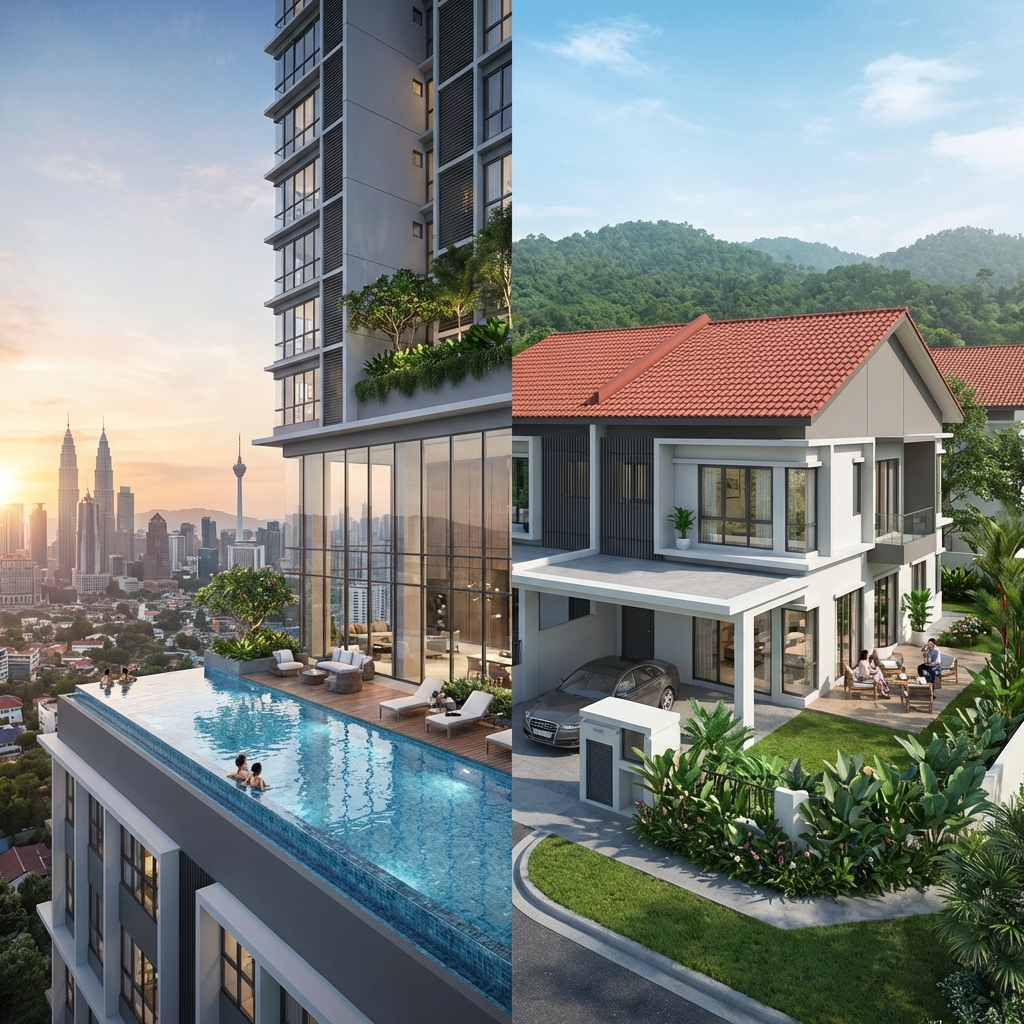
Security and convenience are the biggest draws. Most condominiums offer 24-hour security with guardhouses, access cards, and CCTV coverage. Facilities like swimming pools, gyms, playgrounds, and function rooms are maintained for you and included in your monthly fees.
Condos are frequently located within or near transit-oriented developments, providing walking-distance access to MRT and LRT stations, shopping malls, and commercial hubs. For working professionals, this translates to shorter commutes and a car-lite lifestyle.
Trade-offs include:
- Shared walls and floors mean noise from neighbours is a reality
- Strict management rules may limit pet ownership, renovation scope, and even the colour of window blinds
- Parking is limited to one or two allocated bays, and visitor parking is often scarce
- Common facilities can become crowded in high-density developments
The Landed Lifestyle
Space and freedom define the landed experience. A typical double-storey terrace house offers 1,400 to 1,800 square feet of built-up area, and semi-detached or bungalow homes are significantly larger. You get a private garden, a car porch, and no shared walls (for semi-D and bungalow owners).
Renovation is largely unrestricted (subject to local council permits), allowing you to extend kitchens, add rooms, or reconfigure the layout as your family grows. Pet owners face no management restrictions.
Trade-offs include:
- Security is the owner's responsibility unless the home is in a gated community
- No shared facilities — a gym or pool means building your own
- Pest control, landscaping, and general maintenance fall entirely on you
- Landed homes in suburban locations often mean longer commutes
Which Should You Buy? Decision Framework
There is no universally correct answer. The best choice depends on your specific circumstances. Use this framework to guide your decision.
Choose a Condominium If:
- Your budget is below RM700,000 and you want to buy in a prime urban area
- You prioritise rental yield and plan to use the property as an investment for cash flow
- You are a first-time buyer looking for an accessible entry into the market. Government schemes like SJKP can help with financing
- You value convenience — proximity to transit, built-in security, and maintenance-free facilities
- You live alone or as a couple without immediate need for large living space
Choose a Landed Property If:
- You have a family (or plan to start one) and need space for children, elderly parents, or both
- Your investment horizon is long-term (10 years or more) and you prioritise capital appreciation over rental yield
- You want renovation freedom to modify your home as your needs change over time
- You prefer privacy — no shared walls, no strata rules, no maintenance disputes with other owners
- Your budget allows it — you can comfortably afford the higher entry price without overextending your debt service ratio
The Hybrid Option: Gated and Guarded Communities
If you want landed living with condo-like security and shared facilities, strata-titled gated communities offer a middle ground. Be aware that monthly fees apply and can be higher than typical condo charges due to the larger development footprint.
FAQs: Condo vs Landed in Malaysia
Q: Which is better for families — condo or landed?
Landed properties are generally better for families. They offer more space, private outdoor areas for children to play, and no restrictions on noise or pets. Multi-generational families benefit from the ability to renovate and add rooms. However, family-sized condos (1,200 sq ft and above) in well-managed developments with playgrounds and parks can work well for smaller families who value security and convenience.
Q: Is a condo or landed property a better investment?
It depends on your investment strategy. If you want steady rental income and cash flow, condos deliver higher gross yields of 4% to 6%. If you are building long-term wealth through capital appreciation, landed properties have historically outperformed with 5% to 8% annual growth in urban areas. Many experienced investors hold both types in their portfolio to balance yield and appreciation.
Q: Can foreigners buy landed property in Malaysia?
Foreigners can purchase landed property in Malaysia, but face restrictions that vary by state. Most states impose a minimum purchase price (typically RM1 million or RM2 million) for foreign buyers, and certain property types such as Malay Reserve land and properties below the state threshold are off-limits. Condominiums above the minimum threshold are generally the easier route for foreign buyers. Check the rules for your target state before committing.
Q: Is condo maintenance cheaper than landed property maintenance?
On a monthly basis, condos have a fixed, predictable cost (RM200 to RM800 per month in maintenance fees and sinking fund). Landed homes have no monthly fees but incur irregular, sometimes large repair bills — a full roof replacement or repainting can cost RM10,000 to RM30,000 or more. Over a 10-year period, the total maintenance spend can be comparable, but the cash flow profile is very different. Condo owners pay steadily; landed owners pay in unpredictable bursts.
Ready to start your property search? Browse condominiums and landed homes across Malaysia on SuperHomes. Filter by property type, location, and budget to find listings that match your criteria. If you are still deciding, explore our home loan guide and stamp duty calculator to plan your purchase costs.